
Sutton's GCSE pass rate rose to 73.3%, but its English and maths measure fell. Every school figure published, and why a borough average here is not what it looks like.
Sutton Council says 73.3% of the borough’s students achieved at least five GCSE grades 9 to 4 this summer, an increase of 2.1% on 2025. The figures were published on results day, Thursday 20 August, and the council describes them as early data.
One of the five measures it published went down.
The council’s borough figures are:
- 73.3% of students achieved at least 5 grades 9 to 4, up 2.1% on 2025
- 79.9% achieved grade 4 or above in English and maths, down 1.8% on 2025
- 82.8% attained the English Baccalaureate, up 2.5%
- 76.3% achieved grade 5 or above in English, against 55% nationally
- 70.9% achieved grade 5 or above in maths, against 53.8% nationally
The release does not define any of the five measures, and it does not say where the two national comparisons come from.
The two national figures cannot be checked
Ofqual published its own summer 2026 statistics the same morning. Its data tables report GCSE outcomes at grade 7 and above and at grade 4 and above, and at no other grade. There is no published grade 5 figure for England, so the 55% and 53.8% the council sets its English and maths results against do not appear in the national statistics. Both should be read as the council’s own comparators.
What Ofqual does publish, in table 19a, is that 67.0% of the 5,720,045 GCSE results issued in England reached grade 4 or above, and 21.8% reached grade 7 or above. Table 19b strips out resit candidates and counts only 16-year-olds, which lifts England to 70.7% and 23.1%.
London is the strongest region on both counts. Its 16-year-olds took 75.5% of results at grade 4 or above and 30.2% at grade 7 or above, up from 75.1% and 29.8% in 2025. Sutton sits inside that figure.
There is no official Sutton number
Ofqual publishes no local authority breakdown in its data tables, for GCSE or A level. Its interactive map assigns grades by the postcode of the exam centre rather than where a student lives, so a borough with large selective schools scores on the results of children who travel in.
That matters more in Sutton than almost anywhere. Six of the borough’s secondary schools share a selective eligibility test run through the council’s admissions process:
- Greenshaw High School
- Nonsuch High School for Girls
- Sutton Grammar School
- Wallington County Grammar School
- Wallington High School for Girls
- Wilson’s School
Two more, Carshalton High School for Girls and Glenthorne High School, run aptitude assessments or banding tests.
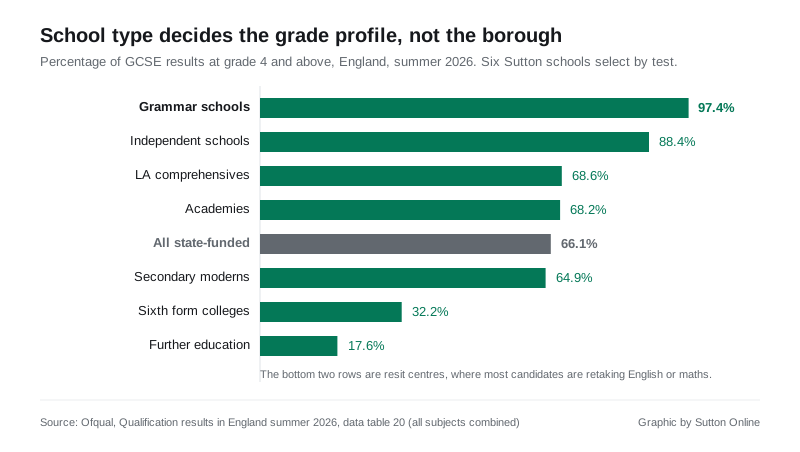
Ofqual’s table 20 shows what school type does to a grade profile nationally:
| Centre type | Grade 4 and above | Grade 7 and above |
|---|---|---|
| Grammar schools | 97.4% | 63.2% |
| Independent schools | 88.4% | 47.1% |
| LA maintained comprehensives | 68.6% | 20.1% |
| Academies | 68.2% | 19.7% |
| Secondary modern schools | 64.9% | 16.8% |
| All state-funded | 66.1% | 20.6% |
| Sixth form colleges | 32.2% | 3.9% |
| Further education | 17.6% | 1.3% |
The bottom two rows are resit centres, not failing institutions. The top row is the reason a Sutton average and a national average are not measuring the same thing.
What each school published
These are the figures Sutton schools put on their own websites on results day. They are not comparable with each other. Some report the percentage of grades awarded, some the percentage of pupils. Selective, comprehensive and fee-charging schools sit in the same list.
| School | What it published |
|---|---|
| Wilson’s School, Wallington | 1,305 of 1,965 GCSE qualifications awarded a grade 9, a record 66.4% of grades; 96.2% at grades 9 to 7 |
| Nonsuch High School for Girls, Cheam | Almost 40% of grades at 9, 68% at 8 and above, 84% at 7 and above |
| Sutton High School GDST, Cheam Road | 23% of grades at 9, more than two-thirds at 9 to 7, almost half at 9 to 8; ten students with straight 9s |
| Glenthorne High School, Sutton | 52% of grades at 7 to 9 and over 15% at grade 9, its best cohort; over 75% at 7 to 9 in biology, chemistry and physics |
| Greenshaw High School, Sutton | 85% of grades at 4 or above, nearly 40% of entries at 7 to 9 |
| Harris Academy Sutton | 82% of pupils at grade 4 or above in English and maths, 70% at grade 5 or above |
| Cheam High School | 78% at grade 4 or above in each of English and maths; 62% at grade 5 or above in both; 776 grades at 7 or above |
| Carshalton High School for Girls | 81% of grades at 4 or above, 68% at 5 or above, nearly a third at 7 to 9; Attainment 8 of 50.93 |
Several schools published no figures at all. Sutton Grammar School called its results the strongest in its history but put the numbers in images rather than text. Wallington County Grammar School’s website was returning an error on 22 August.
Five more had nothing for 2026: Wallington High School for Girls, Overton Grange School, Carshalton Boys Sports College, Stanley Park High and St Philomena’s. The headteachers of Overton Grange and The John Fisher School are both quoted in the council’s release.
The verified school-by-school Key Stage 4 results, on measures that do compare, come later from the Department for Education. Everything published this week is provisional.
What it means for you
If a grade looks wrong, there is a process and it has a hard deadline.
- Both post-results services close on 24 September 2026. A clerical re-check confirms the marks were added up and none were missed. A review of marking puts the paper in front of a second examiner. JCQ gives the awarding body 10 calendar days for the first and 20 for the second.
- The priority service does not cover GCSE. It applies to AS, A level and Level 3 vocational qualifications only.
- A grade can go down. JCQ requires the student’s written consent before a request is submitted, precisely because the mark can fall.
- It goes through the school, not the family. Requests are made by the centre’s exams officer.
- It costs money, per paper. Cheam High School publishes its fees: at GCSE, an AQA clerical check is £9.70 a paper and a review of marking £44.85, Edexcel £14.00 and £50.00, OCR £12.00 and £67.75, WJEC £11.00 and £45.00. Maths has three papers and English language two, so a subject costs several times the headline figure. Other schools set their own arrangements.
For anyone resitting, Pearson Edexcel’s November 2026 timetable puts English language paper 1 on Tuesday 3 November and paper 2 on Thursday 5 November. Maths papers fall on Wednesday 4, Friday 6 and Monday 9 November. All are morning sittings, and entries go through the school.
Sixteen and 17-year-olds must stay in education or training, and the council’s post-16 pages list the local options.
If you are moving house on the strength of a school place, our Sutton house prices page tracks what that costs across the borough, and Sutton council tax bands covers the bill that comes with it.
Sources
- London Borough of Sutton, Sutton GCSE Students Celebrate Results Day, 20 August 2026
- Ofqual, Qualification results in England: summer 2026, data tables 19a, 19b and 20
- London Borough of Sutton, secondary school tests and assessments
- JCQ, post-results services
- Pearson Edexcel, GCSE November 2026 final timetable
- Individual school websites, linked in the table above, as published on 20 to 22 August 2026
Have your say